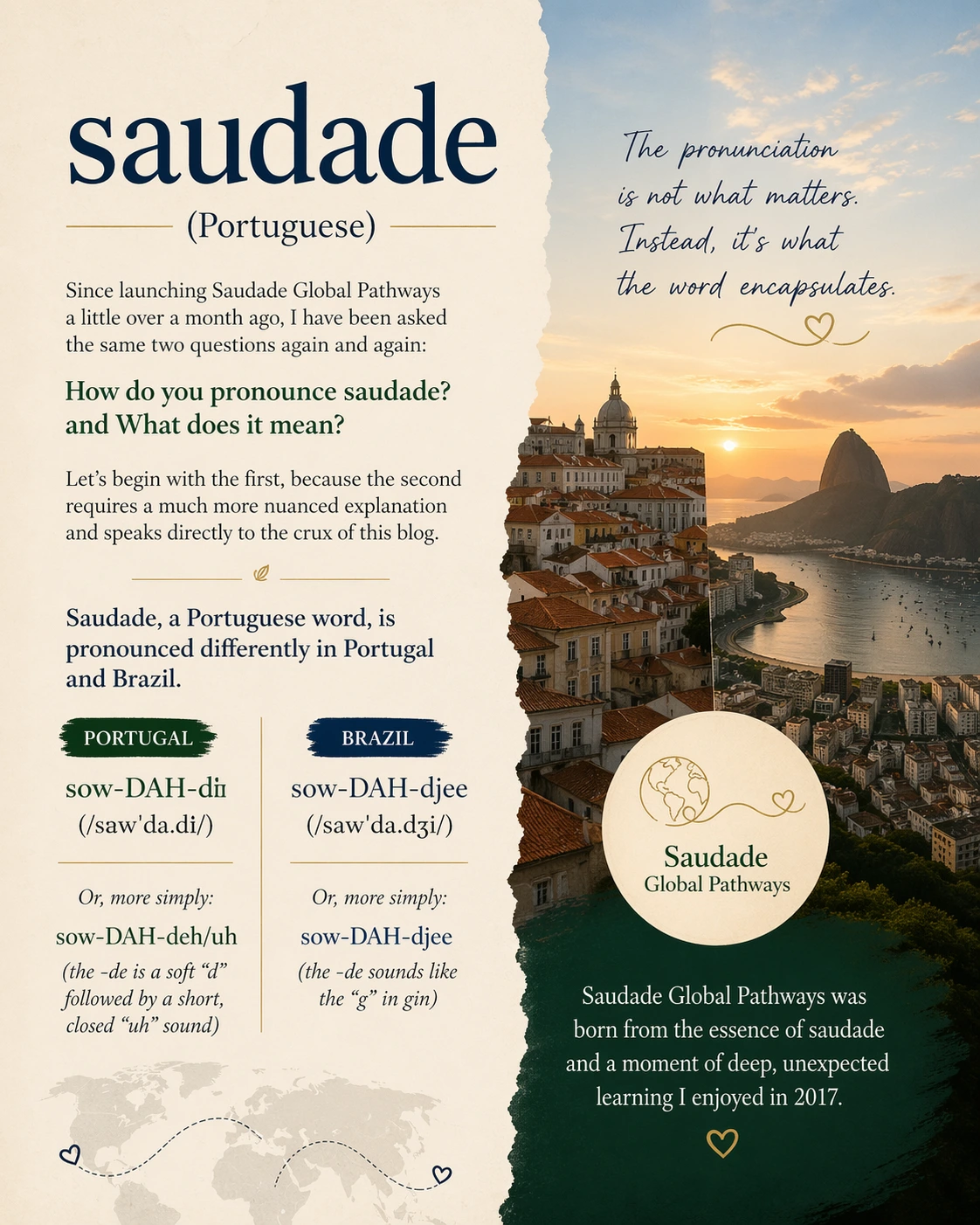
Since launching Saudade Global Pathways a little over a month ago, I have been asked the same two questions again and again: How do you pronounce saudade? and What does it mean? Let’s begin with the first, because the second requires a much more nuanced explanation and speaks directly to the crux of this blog.
Saudade, a Portuguese word, is pronounced differently in Portugal and Brazil.
For my fellow linguists, here is the professional phonetic pronunciation:
Portugal: sow-DAH-dɨ (/sɐwˈda.dɨ/)
Or, more simply: sow-DAH-deh/uh (the -de is a soft “d” followed by a short, closed “uh” sound)
Brazil: sow-DAH-djee (/sawˈda.dʒi/)
Or, more simply: sow-DAH-djee (the -de sounds like the “g” in gin)
The pronunciation, however, is not what matters. Instead, it’s what the word encapsulates. Saudade Global Pathways was born from the essence of saudade and a moment of deep, unexpected learning I enjoyed in 2017.
The best tour. Ever.
While on a site visit in Lisbon to vet a future school program, I joined what became one of the most meaningful tours I have ever experienced. It was unconventional by design. Rather than rushing from landmark to landmark, our guide repeatedly asked us to stop—to close our eyes, to listen, to breathe, to notice the smells and sounds of the city. We experienced Lisbon not as tourists, but as learners fully present in place.
At one point, the guide shared a poem by the Portuguese poet Fernando Pessoa centered on a word many of us had never heard before: saudade. He explained that it has no direct translation in English. It speaks to longing, memory, and love—but also to absence, time, and connection. At the time, the moment felt almost out of context, but later it would take on profound meaning.
At the end of the tour, we stood on a cliff overlooking the Atlantic Ocean. The guide turned to us and said:
“When you are back in your countries, and six months from now you feel a deep yearning to be back here—walking these streets, smelling this city, feeling this moment—and you want to return, but the demands of your everyday life prevent you from doing so… that is saudade.”
That moment stayed with me.
It captured exactly what meaningful global and experiential learning can do. When learning is immersive, human, and connected to place and culture, it does not end when the program ends. It stays with you. It shapes how you see the world—and yourself—long after you return home.
Every program I have ever curated, every tour I have led, and every lesson I have ever taught has, in some way, centered on saudade. As educators, that is always the objective: How do we create learning experiences that are more than fleeting? How do we create moments that inspire a yearning to return, to learn more, to keep filling our cup?
I believe this impulse is innate in great educators. One can be taught the logistics of teaching, but that deeper passion is a gift. As a school administrator who observed countless classes and hired aspiring teachers year after year, I often said I could tell within the first five minutes whether someone had that X factor. What I did not know then was that the X factor was, in fact, the ability to create moments of saudade.
Coming Full Circle
Fast forward almost a decade, and I found myself at a crossroads: remain in brick-and-mortar education, or use my background and expertise to support schools in their efforts to foster meaningful global education.
During a walk with my dog on a crisp fall day—yes, even Miami gets a few of those—I found myself asking the essential questions every aspiring consultant asks, though I admit even that word feels limiting. I prefer collaborators.
Where is my niche? What name could encompass every program I hope to offer within it? How could the mission of my work be captured in one simple word or phrase?
Immediately, I was transported back to July 22, 2017, and that unforgettable tour guide.
Saudade.
That is what this work is about. Those are the moments we, as educators, strive to create. That is the foundation of this next chapter of my professional life. It was a moment of clarity—and, truly, a moment of saudade.
It’s the student whose first plane ride was on your program to Madrid, but who sends you a postcard a decade later from Chile while pursuing a graduate degree.
It’s the adult volunteer in Honduras who returns home so moved by the work of OB-GYNs using outdated equipment that she researches and raises funds for a state-of-the-art ultrasound machine.
It’s the student who had always intended to attend a local college, but—because of the confidence she gained on your high school program abroad—chooses to study nearly 1,500 miles away.
And perhaps that is the true power of saudade. The most meaningful learning does not simply inform—it lingers. It calls us back. In a world that often prioritizes speed and measurable outcomes, saudade asks something different of us as educators: to slow down and create experiences that leave a lasting imprint—to seek out moments that move us, challenge us, and endure. We owe it to ourselves—and to the moments that shape those we teach.